
By; Chase Burke – June 21, 2021
Working in retail real estate, a question I get routinely from prospective tenants is: “What is NNN?” or “What do the 3 N’s mean?”.
These “3 N’s” or “nets” cause a lot of confusion for prospective tenants in the market. Especially entrepreneurs and small business owners that are looking to lease a space for the first time.
If you do not know the answer to this question, or what these “3 N’s” mean, this article is for you. In this article, we will cover what NNN means, how to calculate a tenant’s Pro Rata Share of them, how the NNN’s are paid and accounted for, and what additional costs can be anticipated in addition to these NNN charges.
What is NNN (Triple Net)?
Let us start with the first place everyone should go with any question these days: Google. A quick Google Search of this question and a click over to Investopedia for their definition leads us to a pretty good place to start. Please see the definition below from www.investopedia.com :
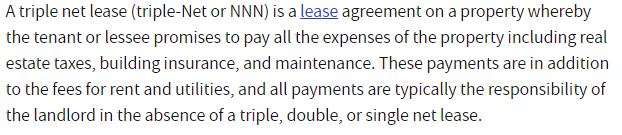
As described above, these “3 N’s” stand for three different expense “pools” for Common Area Operation Expenses that are paid for by a Landlord and reimbursed monthly by the Tenants relating to the common areas of a property. Please see each “pool” below:
- Common Area Maintenance: landscaping, day porter, electricity for the parking lot lights, monument sign lights, repairs, and maintenance to the common area, property management expense etc.
- Insurance: insurance for the property and building.
- Real Estate Taxes: for the property and building.
Now that we have identified what the “3 N’s” stand for, the question is “How much does each tenant need to pay?”. The answer to that question is: their Pro Rata Share.
Pro Rata Share
Each Tenant within a property pays their Pro Rata Share of the NNN expenses for the property. A Tenant’s Pro Rata Share is calculated by dividing the square footage of the Tenant’s Premises by the total square footage (SF) of the entire property. Therefore, for example, if a Tenant occupied a 1,500 SF suite in a 10,000 SF shopping center, the Tenant’s Pro Rata Share of NNN Expenses would be 15%. Please see an illustration of this example below:
| Total SF Occupied by Tenant (the Premises) | 1,500 |
| Total SF in Shopping Center/Property | 10,000 |
| Tenant’s Pro Rata Share of NNN Expenses | 15% |
The above Pro Rata share is used to calculate the Tenant’s actual NNN expenses owed in a calendar year. The Landlord pays these expenses throughout the year and reconciles them at the end of each year to determine the actual Common Area Operating Expenses for the property, for the year. They then multiply the Tenant’s Pro Rata Share by the Total Expenses to determine Tenant’s actual Pro Rata Share of Common Area Operating Expenses for the calendar year. Therefore, for example, if the actual Common Area Operating Expenses for the property in the example above were $30,000.00 ($3 per square foot (PSF)) for the calendar year 2020, the Tenant’s Pro Rata Share of NNN Expenses would be 15% of that equating to $4,500 per year ($3 PSF) or $375 per month ($0.25 PSF). Please see an illustration of this example below:
| Total Actual Operating Expenses for Shopping Center (2020) | $ 30,000 |
| Tenant’s Pro Rata Share % (as calculated above) | 15% |
| Tenant’s Pro Rata Share of Actual Operating Expenses (2020) | $ 4,500 |
| $ PSF Annually | $ 3.00 |
| $ PSF Monthly | $ 0.25 |
Now that we understand what NNN’s are and how the Pro Rata share for each Tenant is calculated, the question is: when are they paid and are they included in the Base Rent?
Payment of NNN’s
The first thing to know about the payment of NNN charge is that they are paid monthly and are estimated based on the prior year actual expenses, with an adjustment for any additional expenditures or inflation that are anticipated in the coming year. Therefore, the payment you make as a Tenant on a monthly basis is an estimate. The Landlord could send you a bill at the end of the year after reconciling NNN expenses if it is determined that the estimate was not sufficient. Alternatively, the Landlord could send you an updated bill with a credit on it if they determined that the estimate was too high. This is similar to a quarterly tax withholding to a small business owner where you are making payments based on a reasonable estimate based on prior years, with the actual amount to be reconciled when all information is available.
For example, lets say that the Landlord estimated that the NNN expenses for the same shopping center in our example above for the calendar year 2020 would be $35,000 ($3.50 PSF annually/$0.29 PSF monthly) and the Landlord billed each tenant $0.29 PSF per month for the entire year. This means that the Landlord overestimated the expenses for the tenants and the tenants would get a $5,000 credit (total) for such overestimate. Assuming the same 1,500 SF was occupied for the entire year (and the Tenant paid Rent and NNN’s according to schedule), the Landlord would owe the 1,500 SF Tenant a credit of $750.00 ($0.50 PSF) — their Pro Rata Share (15%) of the $5,000 overpayment. Please see an illustration of this example below:
| Total CAM Estimate for Calendar Year 2020 | $ 35,000 |
| Total Actual Operating Expenses for Shopping Center (2020) | $ 30,000 |
| Total CAM Overestimate for Calendar Year 2020 | $ 5,000 |
| Tenant’s Pro Rata Share % (as calculated above) | 15% |
| Tenant’s Pro Rata Share of Credit for CAM Overpayment | $ 750 |
Landlords typically reconcile these expenses in the first quarter of each year and send Tenants a “CAM Reconciliation” that is the breakdown of the actual expenses for the prior year vs. the estimated amounts collected. This document serves as back-up for the credit or the bill provided to the tenants. A typical NNN Lease will provide audit rights for tenants to ensure that the Landlord is correctly charging and reconciling these expenses. Staying on-top of these expenses (and ensuring to review the annual reconciliation from the Landlord) is a good practice for any Tenant to keep.
Pro Tenant Tip: negotiate a “cap” on the allowable annual increases to the NNN expenses that are agreed to when you sign the Lease. This will protect you from unforeseen drastic increases in expenses from one year to another. This pro tip deserves a whole article itself, which I wrote and can be found here. National tenants include a “cap” to NNN charges as a standard provision in any LOI that they send to a Landlord. A common request I see in a LOI is a 3% cap on the NNN charges from the previous year.
Lastly, and maybe most importantly, NNN charges are paid IN ADDITION to the Base Monthly Rent that is being quoted and in addition to separately metered utilities.
Yes, that is correct. If you see a marketing flyer quoting $1.50 PSF, NNN – please remember:
- The Base Monthly Rent is $1.50 PSF.
- The NNN charges will be paid in addition to the $1.50 PSF.
- The utilities that are separately metered to the Premises are paid in addition to the Base Rent and NNN charges
- The repair and maintenance of the systems servicing the Premises (including HVAC) are a Tenant responsibility in a NNN Lease
Therefore, continuing off our example above, lets assume that the 1,500 SF suite in the shopping center is now being marketed For Lease. The Landlord is offering the property at $1.50 PSF, NNN and is quoting NNN’s of $0.25 PSF. The Base Monthly Rent would be $1.50 PSF, NNN equating to $2,250 per month. The NNN charges would be $0.25 PSF equating to $375 per month. Therefore, the total monthly payment would be $1.75 PSF, equating to $2,625 per month. Please see an illustration of this example below:
| Total | $ PSF | |
| Base Monthly Rent | $ 2,250 | $ 1.50 |
| Monthly NNN Estimate | $ 375 | $ 0.25 |
| Total Monthly Payment | $ 2,625 | $ 1.75 |
Hopefully you now have a better understanding of what NNN’s are, how the Pro Rata share for each tenant is calculated, how the NNN’s are paid (and reconciled) and that NNN’s are paid in addition to the Base Rent and separately metered utilities. If so, you are a few steps ahead of a lot of retail tenants I know that have went on to sign leases and build very successful businesses.
If you’d like to know more – please feel free to reach out: chase@romecre.com.